
Short answer: for aluminum plantation shutters installed near the sea, we specify a powder coating of 60–80μm dry film thickness (DFT). That is the range that separates a coating that survives roughly 1,000 hours of salt spray from a thinner film that starts failing at around 500.
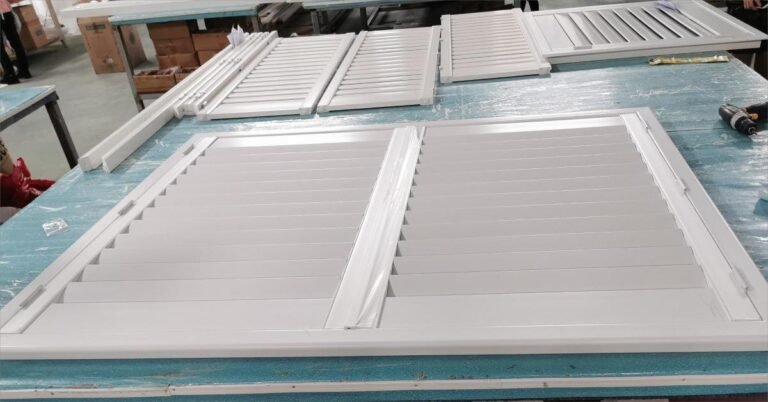
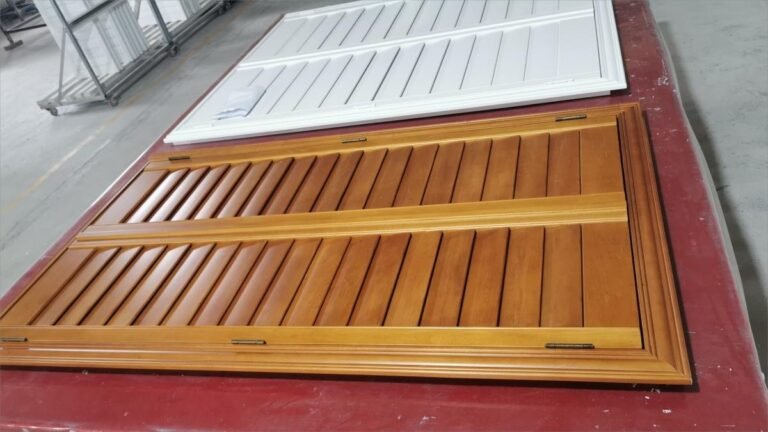
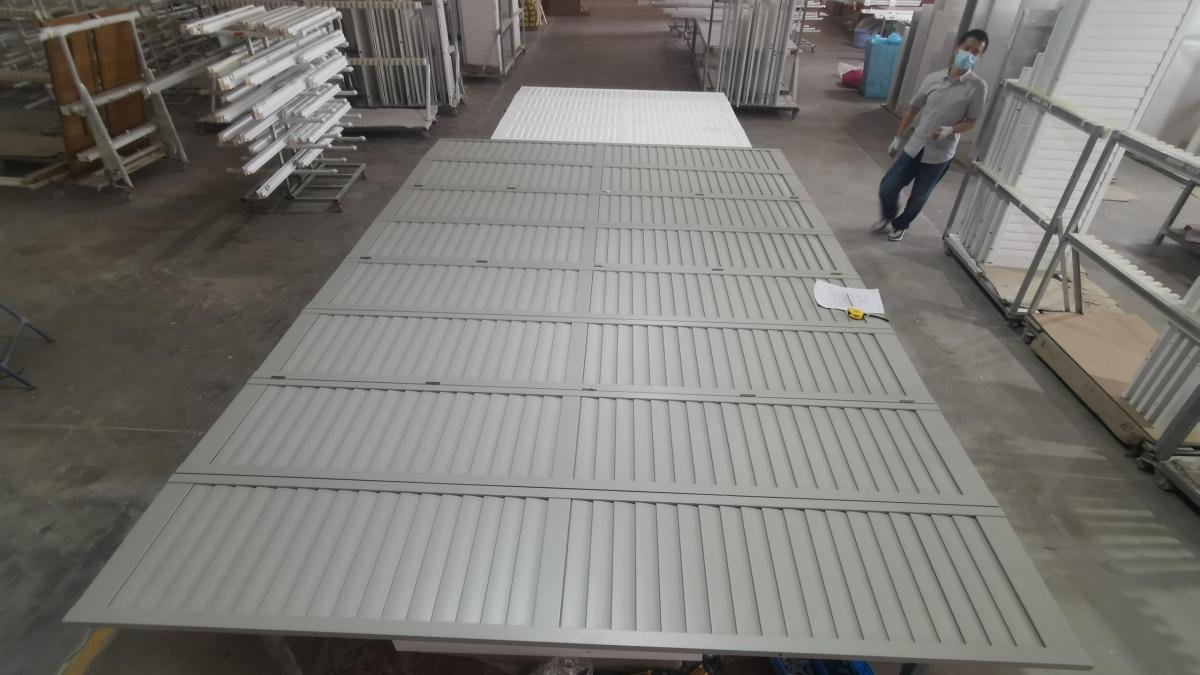
At Goodwood Shutters, we extrude our 6063-T5 aluminum profiles and powder-coat them ourselves, across a production base of more than 50,000㎡ in Xiamen with three automated coating lines. That is why coating thickness is something we control and measure, rather than something we read off a supplier's datasheet. If you are comparing plantation shutter material suppliers for a coastal project, this article explains what to ask for, in terms you can write directly into a purchase specification for aluminum plantation shutters.
Why do aluminum shutters fail near the sea if aluminum doesn't rust?
Aluminum does not form red rust, but its coating can still fail in salt air. Chloride deposits attack weak points in the powder coating, which leads to blistering, under-film corrosion and loss of finish. Steel fasteners and hardware show red rust first.
"Rust-proof aluminum" is a common sales line, and it is only half true. Bare aluminum forms a thin oxide layer that protects it in many environments, but chloride-rich coastal air attacks that layer. On a plantation shutter, the powder coating protects the appearance and the surface of the profile over the long term. When the coating is too thin, chlorides reach the substrate through pinholes and edges much sooner.
The industry method for measuring this is ASTM B117 neutral salt spray testing1, in which specimens are exposed to a continuous 5% sodium chloride fog at 35°C. The practice defines the test environment only. It does not prescribe how long to test or how to interpret the results, so those are agreed between buyer and seller. Blistering is commonly graded with ASTM D7142. ASTM D6103 grades visible rusting, but it is written for painted steel surfaces.
That distinction matters for comparing quotes. When a report says "no red rust at 500 hours," ask which substrate or component was rated and what the pass/fail criteria were. On aluminum profiles the visible failure modes are blistering and coating breakdown, not iron oxide. Suppliers report these differently, which makes their numbers hard to compare.
How thick should powder coating be on coastal aluminum shutters?
Our internal standard for coastal-project orders is 60–80μm DFT, using TGIC polyester powder cured at 200°C for 20 minutes. This is a Goodwood control standard, not an industry mandate. We set it because film thickness is one of the most important variables we can control in salt-spray life.
Here is the reference relationship we work from, based on ASTM B117 test conditions:
| Coating system | Dry film thickness | Typical salt-spray reference (ASTM B117) | Where we would use it |
|---|---|---|---|
| Powder coating, thin film | ~40μm | First visible failure at around 500 hours | Inland, low-humidity projects |
| Powder coating, our coastal standard | 60–80μm | 1,000+ hours | Coastal projects, humid climates |
| Type II sulfuric anodizing (optional) | 15–25μm | 2,000+ hours | Premium projects with higher budgets |
Two points about this table.
First, 500 hours is the minimum pass line we use for coastal orders, and 1,000 hours is the level we recommend. A thin-film coating that clears 500 hours is not a long-term guarantee for a building 200 metres from a beach. If your project is in that position, request the 1,000-hour report rather than accepting the minimum by default.
Second, anodizing performs better in salt spray, but it comes with trade-offs. Under the same test conditions, Type II anodizing can reach more than 2,000 hours, and it typically costs roughly 20–35% more. We treat it as an option for premium projects that can be discussed case by case. For most coastal wholesale and project orders, a properly specified powder coating is the practical balance of cost and service life.
Why does thickness matter so much? A thicker film is a longer path for chlorides to travel before they reach the metal. It also gives the coating more tolerance for the small defects that always exist at corners, edges and cut ends. The cost of getting this wrong shows up slowly, as lifting or blistering years after the shipment was accepted.
The substrate matters too. Our profiles are 6063 aluminum in the T5 temper, which we verify batch by batch with hardness testing rather than relying on supplier statements alone. <!-- TODO: link to W2-2 (T5 vs T4 article) once published --> Temper affects the mechanical behaviour of the louver pivot and gear system, not salt-spray life directly, so we treat it as a separate check from coating thickness.
What should plantation shutter material suppliers show you on a salt spray report?
A useful salt spray report states the surface treatment, the film thickness, the test hours and the evaluation method. A report that only says "passed" cannot be compared with another supplier's quote. We can provide third-party salt spray reports that state the surface treatment specification for the product being tested.
We recommend that buyers, especially project builders, write these items into the specification or purchase order:
| Spec item | What to ask for | Why it matters |
|---|---|---|
| Coating type | TGIC polyester powder coating (or the type you require) | Identifies the chemistry being tested and installed |
| Dry film thickness | 60–80μm for coastal sites, with a stated measurement method | Thickness is a key driver of salt-spray life |
| Cure conditions | Temperature and time (ours: 200°C for 20 minutes) | An under-cured film has weaker adhesion and chemical resistance |
| Test standard | ASTM B1171 | Common method, makes reports comparable |
| Test duration | 500 hours minimum; 1,000 hours recommended for coastal | Defines the acceptance threshold (B117 leaves this to buyer and seller) |
| Evaluation method | ASTM D714 for blistering on the coating; ASTM D610 only for steel components such as fasteners | Defines what "pass" means for each material |
| Test laboratory | An independent third-party laboratory | Avoids reports written by the seller |
| Surface treatment on the sample | Same specification as the production order | Prevents testing a better-finished sample than you receive |
The last row is easy to overlook. A test report is only meaningful if the tested sample used the same surface treatment as the goods you are buying. If your supplier's report does not say what the sample's treatment was, you do not know what was tested.
On our side, coating checks sit alongside our six-part quality control system: IQC, IPQC, FQC, UV yellowing testing, moisture and structural stability testing, and packaging compression testing. If you want a specific coating requirement verified before shipment, tell us at the quotation stage so we can build it into the order.
When is powder coating not enough for a coastal project?
Powder coating is a protective layer that wears, not a permanent barrier. It is most vulnerable where the film is interrupted, such as cut ends, drilled holes and scratches. For severe marine exposure, anodizing or more frequent inspection is the safer route.
We tell customers plainly where coated aluminum has limits:
- Salt spray hours are a comparison tool, not a lifetime promise. The B117 practice itself warns that salt spray results seldom correlate with real-world performance when used as stand-alone data.1 A 1,000-hour result tells you one coating is better than another under the same test. It does not tell you how many years a coastal installation will last.
- A coating is consumable. Even a 60–80μm film ages in strong sunlight and salt air. A thicker film extends service life; it does not make the product maintenance-free.
- Interruptions in the film are weak points. Any site modification that cuts or drills through the coating exposes bare metal. Installers on coastal jobs should avoid unplanned field cutting, and any necessary cuts should be sealed or touched up.
- Hardware is a separate question. The profile may pass a long salt-spray test while a fastener or fitting made from a different material does not. If you are specifying for a marine-exposure site, specify the hardware separately.
- Cold climates change the feel. Aluminum is more stable across temperature swings than PVC or wood, but in very cold European or North American winters its thermal contraction still affects the tilt rod system's operating feel. We raise this during drawing confirmation and recommend allowing a suitable temperature-compensation gap at installation, rather than explaining it after the shutters are fitted.
If your project sits directly on the shoreline with persistent salt mist, our recommendation is to discuss the anodizing option early. The trade-off is cost against service life, and it is best decided before ordering.
What to take away
For aluminum plantation shutters near the sea, the practical specification is:
- 60–80μm DFT TGIC polyester powder coating, with stated cure conditions.
- A third-party ASTM B117 report with 1,000 hours as the target for coastal sites.
- A report that names the surface treatment of the tested sample.
- A clear plan for hardware, field cuts and maintenance, because coating thickness does not cover those.
This is what our in-house extrusion, three automated coating lines and batch-level checks are set up to support. To see how these stages fit into one vertically integrated process, read about our factory.
Planning a coastal project? Confirm our batch QC and test-report documentation for your project, or send us your target coating thickness and salt-spray hours at the quotation stage so we can build them into your quote.
FAQ
Is 500 hours of salt spray enough for coastal aluminum shutters? It is the minimum pass line we use, not the level we recommend for sites close to the sea. For coastal projects we recommend asking for a 1,000-hour report, and treating the result as a way to compare coatings rather than a guarantee of service life.
What coating thickness do you use for coastal aluminum shutters? Our internal standard for coastal-project orders is 60–80μm DFT with TGIC polyester powder, cured at 200°C for 20 minutes. This is our own control standard, not an industry requirement.
Does aluminum rust in salt air? Aluminum does not form red rust, but its protective coating can blister and break down, and steel components such as fasteners can rust. That is why we recommend specifying coating thickness and hardware separately.
Is anodizing better than powder coating near the sea? In salt-spray reference testing, Type II anodizing can exceed 2,000 hours, compared with 1,000+ hours for a 60μm or thicker powder coating. It typically costs about 20–35% more. We treat it as an option for premium projects.
Can you supply a salt spray test report? We can provide third-party salt spray test reports that state the surface treatment specification. Tell us at the quotation stage which standard and test duration your project requires.