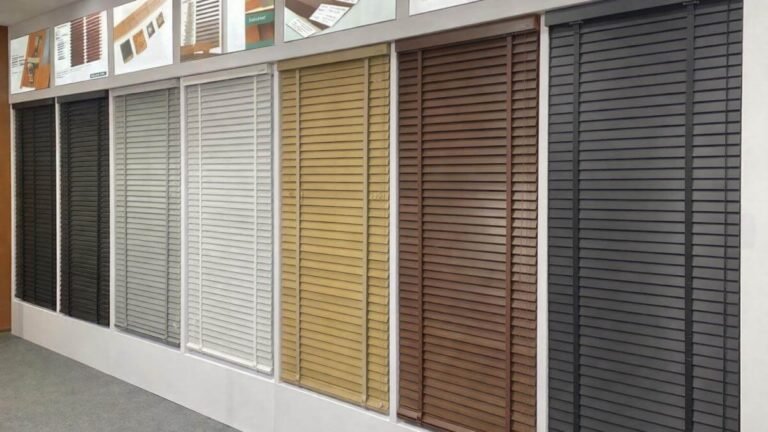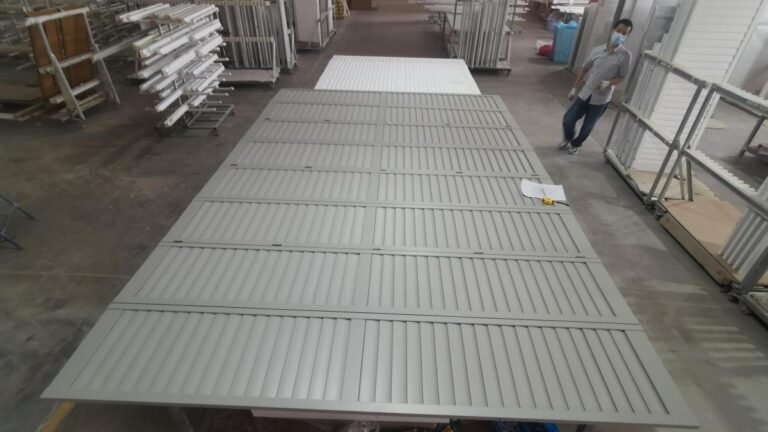

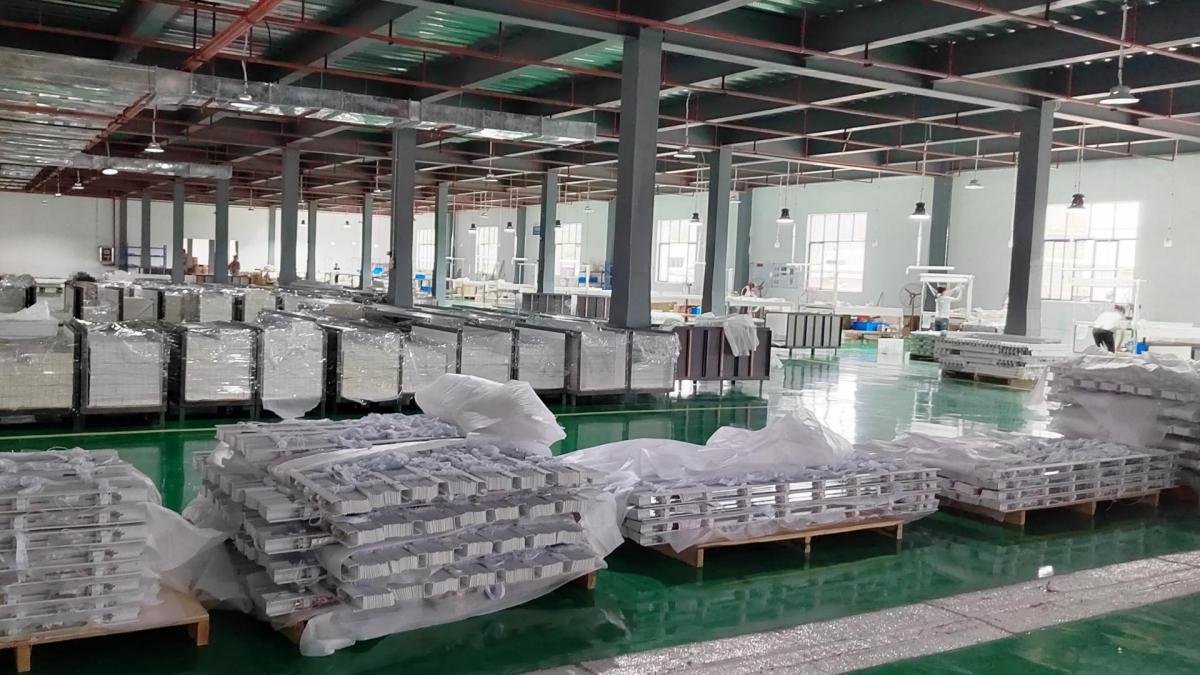
Our production base in Xiamen covers more than 50,000 ㎡, and our venetian blind capacity is 120,000 sets per year. At that volume, one failure mode deserves particular attention when PVC blinds are sold for balconies and terraces: white powder on the slats. A standard indoor PVC venetian blind used outdoors typically starts to chalk after about 18 months. The cause is UV-driven plasticizer migration, not a surface-finish problem. If you are comparing a venetian blinds supplier on price alone, the formula behind the quote is the first thing to check.
This article explains what happens inside the slat, what we change in an outdoor-grade formula, and the questions to put on your RFQ. If you are still choosing a material, our PVC venetian blinds range shows the 25 mm and 50 mm options.
What exactly is "chalking" on PVC venetian blinds, and why does it start around month 18?
Chalking is the white, powdery residue that appears on the slat surface when plasticizer migrates outward and breaks down under UV exposure. In a standard indoor formula, this typically becomes visible after about 18 months outdoors. Indoors, the same slats rarely show it, because UV exposure is far lower.
PVC slats stay flexible because of plasticizer in the compound. Under sustained ultraviolet radiation, that plasticizer moves toward the surface and oxidizes and degrades there. The slat then looks dull and feels dry or slightly tacky, and the white powder wipes off on a finger.
This failure is easy to miss at the factory. A new indoor-formula slat and a new outdoor-formula slat look and feel almost identical on day one. The difference shows up in the second year, long after the shipment has been accepted and paid for. That delay is what makes it a sourcing risk. If the end customer reports it at month 18 or 20, the blame goes to whoever supplied the product.
Chalking is a formulation issue, not a cleaning issue. Wiping the powder off does not stop the process.
How is an outdoor-grade PVC formula different from a standard indoor one?
Our outdoor-grade PVC venetian blind formula lowers total plasticizer from 55 phr to 40 phr, switches to polyester-type plasticizer, and adds a UV absorber and a hindered amine light stabilizer (HALS). These changes slow the migration and degradation that cause chalking. phr means parts per hundred parts of resin.
| Formula variable | Standard indoor PVC slat | Our outdoor-grade formula |
|---|---|---|
| Total plasticizer | 55 phr | 40 phr |
| Plasticizer type | Standard plasticizer | Polyester-type plasticizer |
| UV absorber | Not added as an outdoor package | Added |
| Hindered amine light stabilizer (HALS) | Not added as an outdoor package | Added |
| Relative formula cost | Baseline | About 12–18% higher |
| Typical outdoor life before chalking | About 18 months | About 3× longer (our internal estimate) |
Figures in this table are our internal formulation standards and experience-based estimates. They are not an industry standard.
Each change does a different job:
- Less plasticizer means less material available to migrate. There is simply less to move to the surface.
- Polyester-type plasticizer replaces the standard type. It is part of our outdoor formulation because it suits sustained outdoor exposure better.
- The UV absorber and HALS1 work in different ways. A UV absorber intercepts UV energy before it damages the polymer. HALS do not absorb UV; they scavenge the free radicals that photo-oxidation produces. Running both is a deliberate combination, not redundancy.
Anti-yellowing is a separate variable. Chalking and yellowing are often mixed up in RFQs, but they are different problems. Yellowing is mainly controlled by titanium dioxide (TiO₂) loading. For example, our internal standard for PVC plantation shutters bound for strong-UV markets is at least 10 phr TiO₂. A slat can resist yellowing and still chalk if the plasticizer system is wrong. When a supplier says "UV-resistant," ask which of the two they mean.
Outdoor-grade does not mean maintenance-free. We cover that limit in the last section.
How can buyers tell whether a venetian blinds supplier is really using an outdoor-grade formula?
Ask for the formula type in writing, then ask for evidence. A supplier who quotes "outdoor blinds" without stating the plasticizer and UV-stabilizer system is asking you to trust a label. Because indoor and outdoor slats look the same, paperwork is the most practical check.
We suggest putting these five questions on your RFQ. They apply to any supplier, including us.
| # | Question to ask | What a specific answer looks like |
|---|---|---|
| 1 | Is the quoted slat an outdoor-grade formula, confirmed in writing? | A clear yes or no on the quotation, not "suitable for outdoor use" |
| 2 | What is the plasticizer system and total loading? | A stated type and a phr figure, not a general description |
| 3 | Does the formula include a UV absorber and HALS? | Named as part of the stabilizer package |
| 4 | What UV aging test method was used, and what was the result? | A named method with duration and a colour-change (ΔE) result |
| 5 | Can the test report be traced to the formulation batch? | A report that references the batch, from an independent laboratory |
On question 4, a method buyers often reference is ASTM G1542, a practice for running fluorescent UV lamp apparatus. Its Cycle 1 setup commonly uses UV-A 340 nm lamps, with 4 hours of radiation at 60°C alternating with 4 hours of condensation at 50°C. The standard itself covers how the exposure is run; it does not set pass or fail limits, so the buyer's specification has to define them. As a practical reading of a 500-hour result, we use colour change measured as ΔE on the CIE 20003 scale. In our internal reading, 1.5 or below is a premium result, 1.5–3.0 is acceptable, and above 3.0 is a fail. These thresholds are our own working criteria, not part of ASTM G154.
Note that colour change mainly tells you about discolouration. It does not directly measure chalking, so for outdoor use also ask how the supplier checks surface condition after exposure. We list the test method here because buyers often reference it, not as a claim that every supplier or product has been tested to it.
You can also look at the supplier. A factory that controls its own extrusion and slat production can answer questions 2 and 3 from its own records. A trader reselling slats from several sources often cannot. This is one practical reason we do our own work in-house, as described in our vertically integrated manufacturing setup.
Is the extra 12–18% formula cost worth it?
For any application where the blinds will see sustained UV, yes. By our estimate, a formula that costs about 12–18% more lasts about three times longer outdoors. The rest of this section is simple arithmetic on those two internal figures, not a measured result for any specific project.
If a standard formula starts to chalk at about 18 months, a roughly threefold extension puts the equivalent point near four and a half years. The formula premium applies only to the material cost of the slat. It does not apply to headrail, packaging, freight, or installation, and those costs are the same whether the formula is indoor or outdoor grade. The premium is also paid once, at purchase, while the failure is paid for at replacement.
For a wholesaler or importer, the more important cost is rarely the slat. It is the replacement shipment, the credit note, and the damaged relationship with an end customer, all triggered by a defect that appeared after the sale was closed. Customers who sell to balconies, conservatories, or covered terraces should price the product on the longer timeline.
This also gives you a way to read competing quotes. If two PVC venetian blinds suppliers quote prices that are 12–18% apart for the same slat size, the cheaper one may be using the standard indoor formula. That is worth confirming before you treat the difference as margin.
When should you not use outdoor PVC venetian blinds at all?
Outdoor-grade PVC slows chalking but does not stop it forever, and it is not a fit for every exposed location. We would rather you know this before you order than after.
Three limits to keep in mind:
- "About three times longer" is our internal estimate. It is not a guarantee for your climate. Exposure varies, and a south-facing, high-UV location will age slats faster than a shaded one.
- Direct, continuous exposure to weather is a different category. Venetian blinds are a window and shade product. If your project means fully open exposure to rain and wind, you should assess whether a venetian blind is the right product form at all, regardless of formula.
- Wood is the wrong choice for humid or wet areas. In our experience, wood venetian blinds in high-humidity spaces last only about 30–40% as long as PVC in the same conditions. Even with waterproof coating, the exposed slat ends take up moisture, and slats can swell and deform after one to two years above 80% relative humidity. For balconies and similar semi-outdoor spaces, we recommend PVC over wood.
We make 25 mm and 50 mm venetian blinds in wood and PVC. We would rather recommend the right material for the installation than quote a wood product as waterproof when it is not.
Frequently Asked Questions
Is white powder on PVC venetian blinds a quality defect?
Usually it is chalking, a UV-related formulation effect rather than dirt. It appears when plasticizer migrates to the slat surface and degrades. If it shows up after about 18 months on blinds used outdoors, the likely cause is a standard indoor formula in an outdoor location. Wiping it off does not fix the cause.
Can standard indoor PVC venetian blinds be used on a balcony?
They can, but expect chalking to appear after about 18 months under sustained UV. For balconies, terraces, and other high-UV locations, specify an outdoor-grade formula and ask the supplier to confirm it in writing.
How much more does an outdoor-grade PVC venetian blind formula cost?
In our formulation, the formula cost is about 12–18% higher, with an estimated service life about three times longer outdoors. These are our internal estimates. The premium applies to slat material cost, not to the whole blind.
Does an anti-yellowing additive also stop chalking?
No. They are separate variables. Titanium dioxide loading mainly controls yellowing, while chalking depends on the plasticizer and UV-stabilizer system. Ask suppliers to state both.
What lead time should I expect for PVC venetian blinds?
Our venetian blinds lead time is 20–30 days, and sample making takes 3–7 days. Lead times for other product lines differ, so please confirm each line separately when you request a quote.
Next step
If you are sourcing PVC venetian blinds for resale into balcony, terrace, or other high-UV projects, request our wholesale price list and lead time schedule, and tell us the exposure conditions so we can quote the right formula. You can also ask which test documentation can be made available for your target market. If you are a window and door company thinking about adding venetian blinds as a value-add line, see our solutions for window and door companies.
To see how formulation control fits into the rest of our production, read about our vertically integrated factory.
Read a practical overview of how UV absorbers and hindered amine light stabilizers protect plastics in different ways. ↩
Open the standards page to see what ASTM G154 covers and how its UV lamp exposure practice is scoped. ↩
See the international standard that defines the CIE 2000 colour-difference formula behind ΔE values. ↩