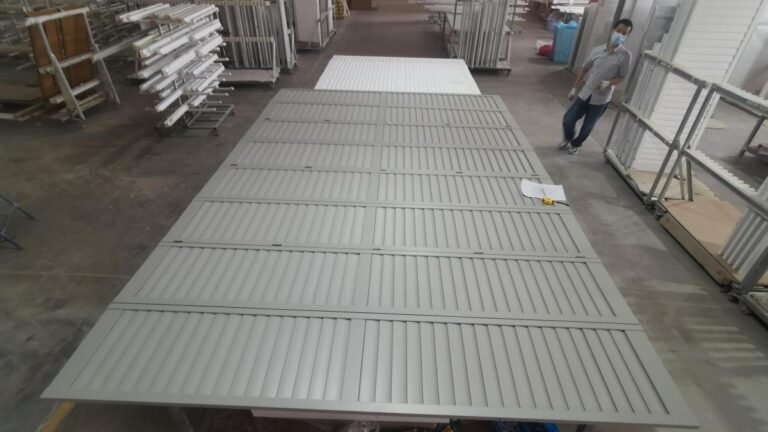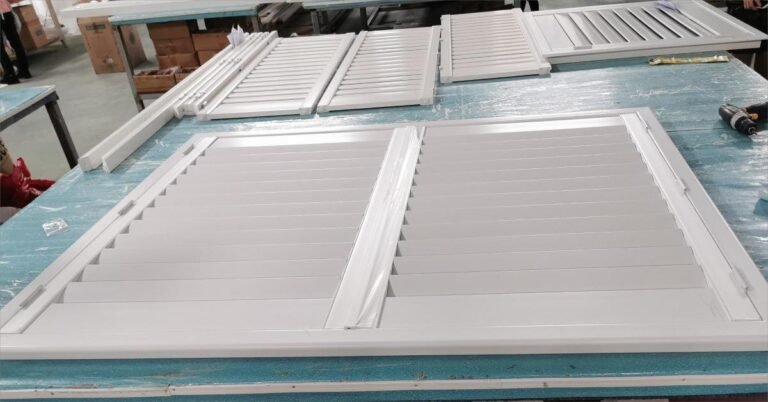

You unbox a new venetian blind, lay a slat on the table, and the middle sits slightly higher than the ends. Your first thought is probably "defective batch." In most cases it isn't. As a venetian blinds manufacturer founded in Xiamen in 2008, with a production base of over 50,000 ㎡, we build a small amount of bow into certain slats on purpose. It is such a common source of false complaints that we added a dedicated explanation to our distributor training materials.
This article explains what the bow is, why it exists, and how to tell it apart from a real quality problem.
Is it normal for new venetian blind slats to be slightly bowed?
Yes. A slight preset bow is a deliberate design feature, not a flaw. In the aluminum slats covered by our distributor training notes, the slat leaves the factory with its center sitting roughly 0.5–0.8mm higher than its two ends when laid flat.
You can check this yourself:
- Lay one slat, convex side up, on a flat table.
- Press the ends lightly against the surface.
- Measure the gap under the center with a feeler gauge or a thin ruler.
A gap in the range of about 0.5–0.8mm is the intended preset bow. On a slat only 25mm (1") or 50mm (2") wide, a curve this small is easy to mistake for a defect once you have noticed it.
A scope note: the 0.5–0.8mm figure comes from our internal standard for aluminum slats. Wood and PVC slats behave differently, and we don't apply this number to them (see the third section).
Why do manufacturers build a slight bow into the slat on purpose?
The bow compensates for gravity. Once a slat is installed, its own weight, plus the tension from the ladder strings it hangs on, gradually pulls it toward a flat state. A slat designed to be perfectly flat at the factory can end up sagging in the middle after installation, which is the opposite of what you want.
In practice:
- A slat that leaves the factory with a slight upward bow settles toward flat once it is hanging.
- A slat that leaves the factory perfectly flat tends to sag in the middle after installation.
- The effect is most noticeable on slats wider than 1800mm, where the unsupported span is longer and gravity has more leverage.
This is an engineering trade-off, and it is our standard approach rather than an industry mandate. Other manufacturers may handle it differently, and the right amount of bow depends on slat material, thickness, and width. The table below shows the slat specifications our aluminum standards cover.
| Slat width | Thickness options | Alloy temper | Typical positioning |
|---|---|---|---|
| 25mm (1") | 0.18mm | 8011-H14/H24 | Residential entry level |
| 25mm (1") | 0.20mm | 8011-H14/H24 | Commercial standard |
| 25mm (1") | 0.22mm | 8011-H14/H24 | Commercial, high-frequency use |
| 50mm (2") | 0.28mm | 8011-H14/H24 | Standard |
| 50mm (2") | 0.35mm | 8011-H14/H24 | Commercial |
Thickness and temper figures reflect our aluminum slat specifications; H14 and H24 are strain-hardened temper codes1. For high-frequency settings such as hotel rooms, where blinds may be operated about 3,650 times a year, we recommend 0.20mm or thicker H14 slats.
Thinner, wider slats are more flexible, so the same gravitational pull flattens them more readily. A designer working with a 0.18mm slat therefore thinks about preset bow differently than one working with a 0.35mm slat. The point of the table is that slat geometry and bow are linked, not that one number fits every blind.
How can I tell a normal bow from a real defect?
A normal preset bow is small, smooth, and symmetrical, and it relaxes after the blind has been hanging. A real defect is usually abrupt, uneven, or still getting worse. We don't want to leave you with the impression that every curve is acceptable, because it isn't. The table below separates the cases.
| What you see | Likely cause | What to do |
|---|---|---|
| Smooth, symmetrical, slight center-high curve (about 0.5–0.8mm on aluminum slats) | Intended preset bow | Hang the blind and let the slats settle |
| Slat sags in the middle after installation | Very wide span, or a slat that has no preset bow | Measure the width against the 1800mm guidance above, then contact the supplier |
| Slats stack unevenly or leave uneven light gaps when closed | Ladder string clamp position outside tolerance | Check the clamp position (see below) |
| Creases, kinks, or twisting along a slat | Handling or shipping damage, or a forming defect | Photograph and report it |
| Wood slats swell or warp in a bathroom or laundry | Moisture, not preset bow | Relocate to a dry area or switch material |
Ladder string placement is an often-overlooked cause. In our assembly drawings, the ladder string clamps each slat at 3.0 ± 0.5mm from the slat edge. If the clamp sits outside that range, the lever arm changes and the slat is pulled into a slight tilt under gravity and string tension. The result looks like a bowed or crooked slat, but the real issue is clamp position. This is one of the most common causes of "my blind won't stack neatly" complaints, and also one of the hardest to explain to a customer.
Some honest limits on everything above:
- Settling takes time. The preset bow does not vanish the moment the blind is hung. It relaxes gradually under the slat's own weight.
- A bow outside the intended range is still a problem. If a slat is bowed well beyond a slight, smooth curve, is twisted, or bends the wrong way, that isn't preset bow, and we would rather you flag it than assume it is fine.
- Wood is different. Wood venetian blinds are sensitive to humidity. In bathrooms, saunas, or laundry rooms, wood slats typically last only about 30–40% as long as aluminum or PVC blinds in the same conditions. Even with a waterproof finish, the slat ends remain the main route for moisture, and after one to two years above 80% relative humidity, the slats can swell and deform. That is a material response to moisture, not a preset bow. In wet areas we recommend aluminum or PVC, and we won't promise that a wood blind is "very waterproof."
What does a venetian blinds manufacturer recommend when a customer reports bowed slats?
We suggest a short, consistent triage routine before any return is authorized:
- Measure first. Lay a slat on a flat surface and measure the center gap. Record it with a photo that includes a ruler.
- Let it hang. If the bow is within the slight, smooth range, hang the blind and let the slats settle under their own weight before judging.
- Check against the defect table. If the blind still shows uneven stacking, uneven light gaps, creases, or reverse sag, check the ladder string clamp position and the slat width. If neither explains it, collect photos and the batch information and send them to us.
A one-page version of this routine for installers means everyone measures the same thing, which keeps real issues from being dismissed and avoids returns for a feature that is working as designed.
We make 25mm and 50mm wood and PVC venetian blinds, with corded and cordless options, on a lead time of 20–30 days (Window Shades run on a separate 7–15 day schedule). If you are a wholesaler or distributor, request our wholesale price list and lead time schedule and we will walk you through slat specifications, batch tolerances, and how we document them. You can also browse our wholesale window blinds range or contact us directly.
FAQ
Why are my new venetian blind slats curved instead of flat? A slight curve is usually a deliberate preset bow. In our aluminum slats the center sits about 0.5–0.8mm above the ends so that gravity brings the slat toward flat once it is hanging, instead of leaving it sagging.
Will the bow go away after the blind is installed? It relaxes gradually under the slat's own weight, not instantly. If the slats still show a pronounced, uneven, or reversed curve after hanging for a while, that is not preset bow, and you should photograph it and contact your supplier.
How much slat bow is normal? For our aluminum slats, about 0.5–0.8mm center-high when laid flat. This figure is our internal standard, not an industry rule, and it does not apply to wood or PVC slats, which respond mainly to humidity and temperature.
Why do my blinds stack unevenly or leave uneven light gaps? Often the cause is ladder string clamp position rather than slat shape. Our standard is 3.0 ± 0.5mm from the slat edge, and clamps outside that range tilt the slat and produce ragged stacking and uneven gaps.
A plain-language breakdown of what aluminum temper codes such as H14 mean for hardness and strength. ↩