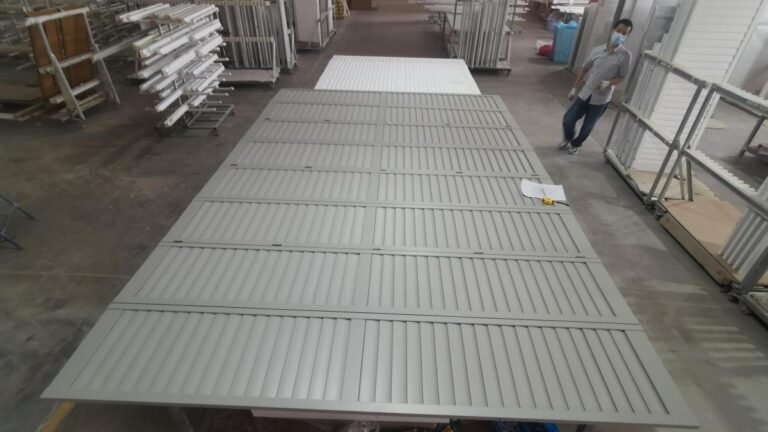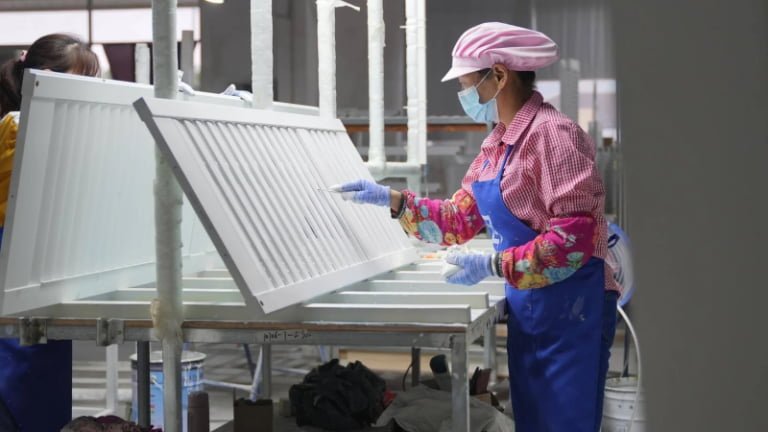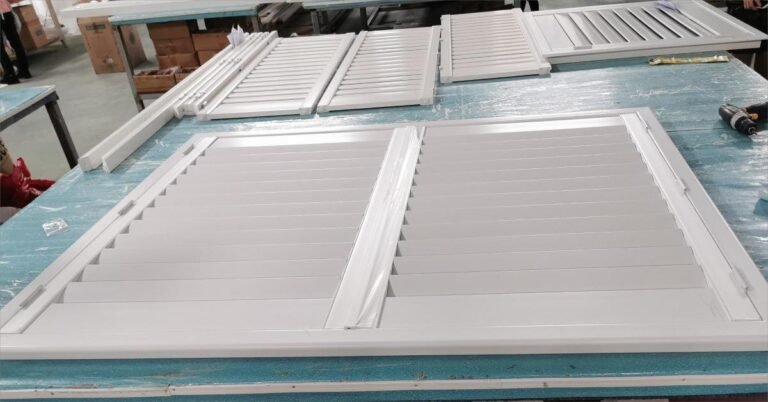


Since 2008, we have built wood plantation shutters at our Xiamen base, which covers 50,000+ ㎡ and runs 20+ CNC machining centers. Over those years we have learned that "solid wood" on a quotation sheet can hide a lot of variation. The biggest variable is often invisible: the finger joints inside longer rails and stiles. This article explains what finger-joint lumber is, which specifications decide whether it holds, and where it tends to fail.
What is finger-joint lumber, and why do shutter factories use it?
Finger-joint lumber is made by cutting interlocking, finger-shaped profiles into the ends of short wood pieces, gluing them together and pressing them into one long piece. Factories use it for rails and stiles longer than 1,200mm (about 47 in), where a single piece of solid hardwood becomes too expensive. It is a legitimate process, not a defect.
The method is common across the wood shutter industry. A typical solid-wood production route runs through cutting, finger-jointing, sanding and finishing. The real question is not whether a supplier uses finger joints but how well the joints are made.
Long, straight, defect-free timber is scarce and costly. Joining shorter clear pieces lets a factory use material efficiently and still deliver long, dimensionally stable components. We use finger-jointed material for exactly this reason. The same process can produce a strong joint or a weak one, so the specification matters.
What finger-joint specifications separate a strong joint from a weak one?
Three geometry values and one test reference separate strong joints from weak ones. Our internal standard is a 3.8mm tooth pitch, a tip radius of 0.2mm or less, and a tooth depth of 9–11mm. This geometry lets the joint reach over 75% of the strength of clear (unjointed) wood, tested with reference to ASTM D55721.
Here is how our standard compares with a coarser alternative we have seen in the market:
| Parameter | Our standard (fine pitch) | Coarse-pitch alternative |
|---|---|---|
| Tooth pitch | 3.8mm | 4.5mm |
| Tip radius | ≤0.2mm | — |
| Tooth depth | 9–11mm | — |
| Joint tensile strength vs. clear wood | 75%+ | About 55% |
| Machining time | Baseline | About 15% less |
| Our use | Adopted | Not our process route |
Strength figures are tested with reference to ASTM D55721, a published specification for adhesives used in finger joints of nonstructural lumber products. We follow it; it is not a Goodwood-developed standard. The geometry values are our internal control standard, not an industry requirement.
The coarse-pitch route saves about 15% of machining time and costs about 20 percentage points of joint strength. For a factory competing purely on price, that trade can look attractive. At the finished-shutter level the savings are small, but the weakness sits inside the frame, where nobody sees it at delivery. We have seen coarse-pitch joints used elsewhere, and that is the reason we do not use them.
Geometry is only half the story
A well-cut joint still depends on what goes into it.
Moisture content. A finger joint glued from wood with uneven moisture will not stay stable. Surface readings can mislead, because a pin-type moisture meter only reads the outer 5–8mm of the board. That is why our incoming inspection adds cross-section moisture testing: we cut sample boards, measure surface and core separately, and require the difference to be 2% or less. Our baseline reference method is oven-drying per ASTM D4442 Method B2. This is a separate check from joint geometry, but both have to pass.
Adhesive chemistry. Finger-jointing and composite wood parts often use urea-formaldehyde adhesives, which release formaldehyde. For US-bound orders, the reference standard is CARB P23 (0.05 ppm for hardwood plywood, 0.11 ppm for MDF). EU-bound orders refer to the E1 emission class4, and some buyers specify a stricter "E0" grade. Our requirement is that adhesive suppliers meet both systems, rather than one market's limit being treated as universal. These are industry standards that we reference; the details of your target market's requirements should be confirmed in your order documentation.
When does a finger joint fail on a plantation shutter?
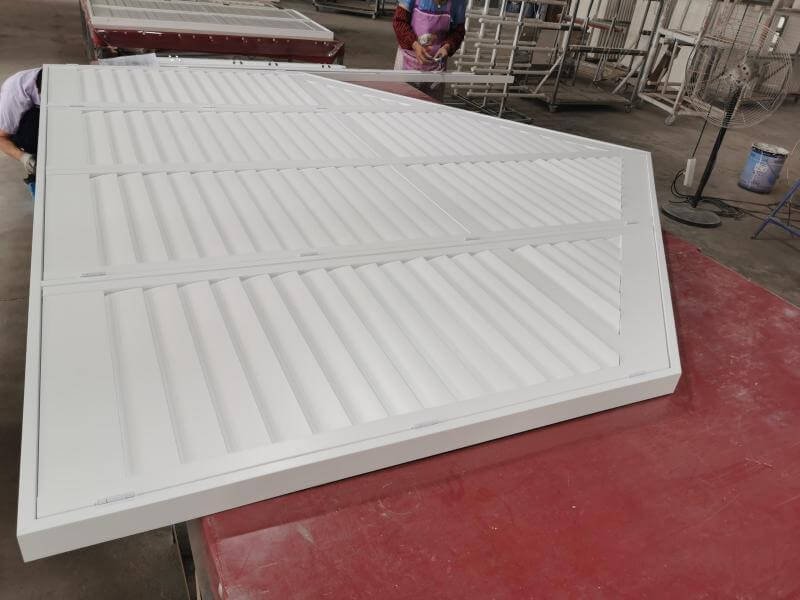
A finger joint fails when weak geometry meets high load. In our experience, the typical failure pattern is a coarse-pitch joint in a wide opening, over 1,500mm (about 59 in) of span, showing visible frame bending within 1–2 years. The joint is the weakest link in the frame, so it deforms first.
The logic is straightforward. A joint at roughly 55% of clear-wood strength carries the same load as a 75%+ joint but with far less margin. Wide panels create longer unsupported spans and more leverage on every joint. Daily operation, seasonal humidity swings and temperature changes all add cyclic stress. A joint with little reserve strength will slowly give way, and the bow becomes visible on the finished panel.
This is why we treat the three variables together rather than separately:
- Pitch and geometry (strength of the joint itself)
- Span (how much leverage the frame puts on it)
- Moisture condition (how stable the wood is around the joint)
Honest limits: what finger-jointed wood cannot solve
We believe buyers should hear these limits before ordering, not after.
Finger-jointing does not make wood immune to climate. In environments with average relative humidity above 70% and large seasonal swings, wood shutters can show 0.5–1.5mm of louver warp after 10 years, even with moisture-resistant primer. This is not a manufacturing defect. It is natural wood responding to humidity cycles, and good joints do not prevent it. In those climates we recommend considering PVC shutters instead. Wood's real advantage is appearance, and the buyer should weigh that against long-term maintenance.
Wide openings need extra scrutiny, not blind trust. Even a well-made joint is not a substitute for appropriate frame design. If a project drawing includes spans beyond 1,500mm, raise the configuration with your supplier at the drawing stage, not after installation.
We do not claim a joint spec guarantees a lifetime outcome. The 75%+ figure describes joint strength against clear wood. It does not describe how a finished shutter will behave in every climate, load and installation condition.
What should buyers of wholesale interior shutters ask a supplier about finger-jointed frames?
Ask for numbers, not reassurance. Four questions expose most weak joint practices: What is the tooth pitch? What is the measured joint strength against clear wood, and by which method? How is core moisture content verified? Where do you use finger-jointed material, and where do you not?
A supplier who can answer these precisely has probably controlled the process. One who answers "it's all high-quality wood" has not answered.
| Question to ask | What a good answer sounds like |
|---|---|
| What tooth pitch, tip radius and depth do you use? | Specific millimeter values, not "standard" |
| How is joint strength verified? | Names a test method (e.g. ASTM D5572) and a result relative to clear wood |
| How do you check moisture content? | Mentions core readings or oven-dry testing, not only a surface meter |
| Which adhesive emission standard do your suppliers meet? | Names the standard for your target market |
| Where is finger-jointed lumber used in the frame? | States where it is and isn't used, and the spans involved |
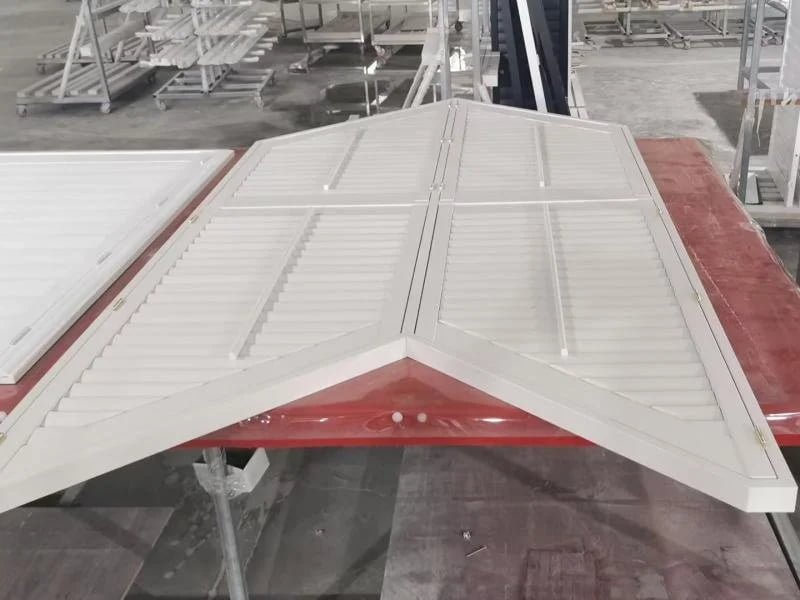
On our side, this inspection sits inside a six-part quality system covering incoming material checks (IQC), in-process inspection (IPQC), final inspection (FQC), UV yellowing resistance testing, moisture and structural stability testing, and packaging compression testing. For wood shutter orders, we can walk you through how the joint and moisture checks fit into those steps. We produce 280,000 plantation shutter sets per year, and our delivery time for plantation shutters is 20–30 days.
A finger joint is just a tool. Made to a fine pitch, from properly dried wood and bonded with controlled adhesives, it gives you long, stable frame parts at a sensible cost. Made to a coarse pitch for speed, it can bow your wide panels within two years. Put the questions above to any supplier of wholesale interior shutters, and compare the answers before you compare the prices.
Frequently Asked Questions
Is finger-jointed lumber lower quality than solid wood in plantation shutters?
Not by default. Finger joints let a factory make rails and stiles longer than 1,200mm without the cost of single-piece solid hardwood. Quality depends on joint geometry (our standard is a 3.8mm pitch, 0.2mm maximum tip radius and 9–11mm depth), the moisture condition of the wood and the adhesive. A poorly specified joint is the problem, not the process itself.
What should I ask a supplier of wholesale interior shutters about finger joints?
Ask for the tooth pitch, tip radius and depth in millimeters, how joint strength is tested against clear wood, how core moisture is verified, and where finger-jointed parts are and are not used. Specific numbers suggest a controlled process. General reassurance such as "high-quality wood" does not answer the question.
Do finger joints make wood shutters warp?
Humidity drives warp more than the joint does. In environments with average relative humidity above 70% and large seasonal swings, wood louvers can warp 0.5–1.5mm over 10 years, even with moisture-resistant primer. This is natural wood behavior, not a defect. Good joints do not prevent it, so in those climates we suggest considering PVC.
How wide can a finger-jointed shutter frame be?
We apply extra scrutiny to spans over 1,500mm (about 59 in), because coarse-pitch joints in wide openings can show visible bending within 1–2 years. We do not claim one maximum span fits every project. Wide configurations are best reviewed at the drawing stage, together with the joint specification and moisture condition.
How is wood moisture checked before it goes into frame parts?
Our incoming inspection adds cross-section testing: we cut sample boards, measure surface and core moisture separately, and require the difference to be 2% or less. A pin-type meter alone reads only the outer 5–8mm, so it can miss moisture still held in the core. This is our internal standard, not an industry mandate.
Planning a wood shutter project? Request our wood shutter specifications and ask which compliance documentation is available for your target market. Wholesalers, importers and project builders can also ask for our lead-time schedule by product line.
Request wood shutter specifications and documentation · See our wood plantation shutter range
Open this to read the scope of the specification covering adhesives used in finger joints of nonstructural lumber products. ↩
Open this to see how the standard defines the oven-drying methods for measuring moisture content in wood. ↩
Open this to see how California's formaldehyde emission rules for composite wood products are structured. ↩
Open this to see how the E1 and E2 formaldehyde emission classes for wood-based panels are defined. ↩