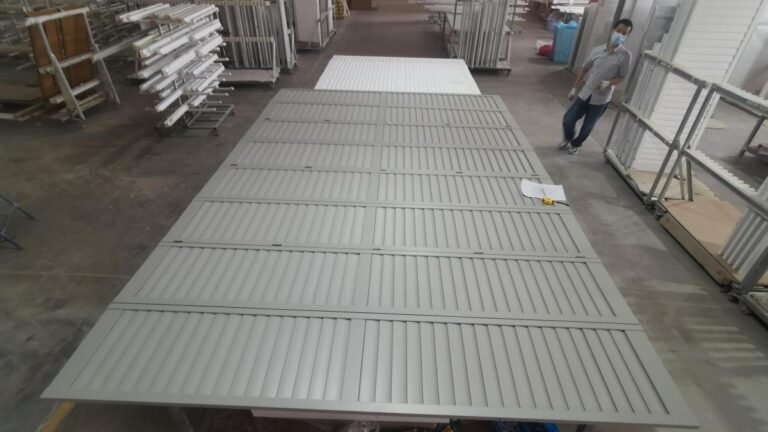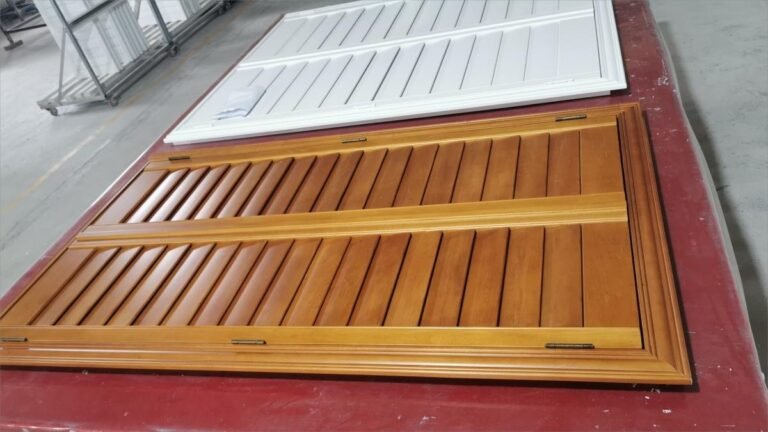

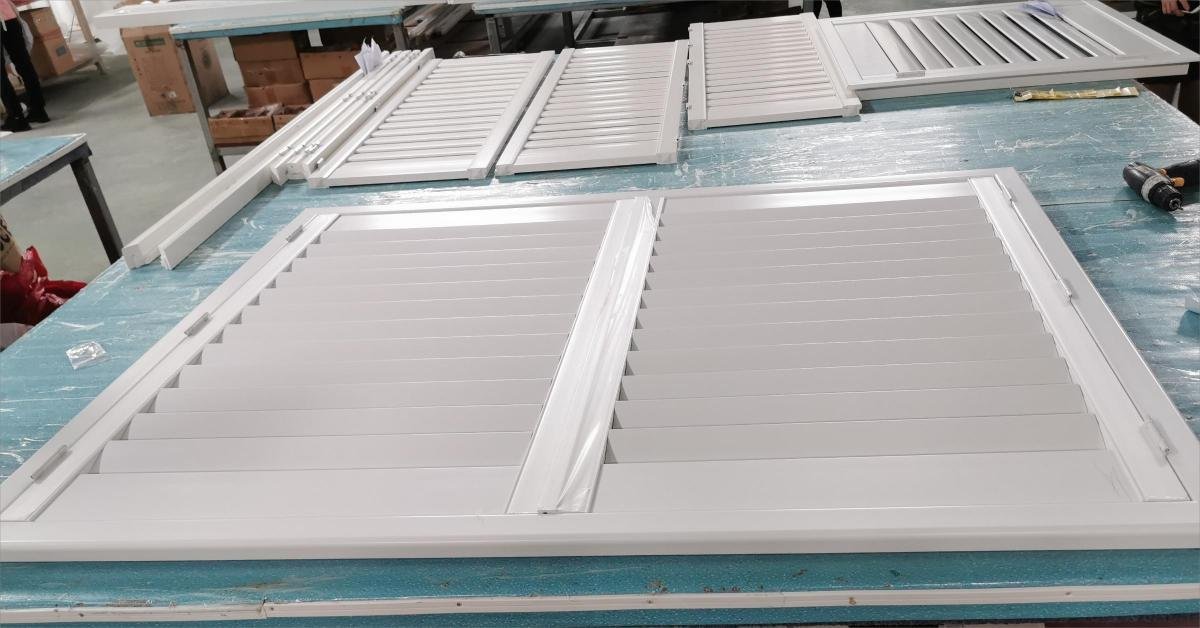
If you are comparing a plantation shutters supplier for the first time, the quote sheet can read like a foreign language. We have manufactured window coverings in Xiamen since 2008, from a 50,000+ ㎡ production base with 400+ staff, and the same questions come up in nearly every sourcing conversation: what is a T-Post, does louver width matter, and which tilt rod system is actually better? This glossary explains each term in plain language and tells you what to check before you sign off a specification. Whether you are screening window shutter suppliers or writing a spec for a project, the goal is the same: know which words describe a real technical choice.
Measurements below are in millimetres, with inches in brackets on first use.
What are the parts of a plantation shutter, and what is each one called?
A plantation shutter is a hinged panel inside a fixed frame. The panel holds adjustable louvers (the slats), which are tilted together by a control system such as a tilt rod. Large panels may add a T-Post or divider rail. Each part is a separate spec line on a quote.
| Term | What it is | What to ask a supplier |
|---|---|---|
| Frame | Fixed outer structure fixed to the window opening | Material, profile size, and whether it suits inside or outside mount |
| Louver | The adjustable horizontal slat that controls light and view | Width, thickness, and material |
| Stile and rail | The vertical (stile) and horizontal (rail) members that form the panel around the louvers | Solid or finger-jointed wood; extrusion wall thickness for PVC and aluminum |
| Tilt rod | The control bar that tilts all louvers together | Where it attaches, and how the linkage is built |
| T-Post | A vertical divider that supports louvers on wide openings | At what width it becomes necessary |
| Divider rail | A horizontal rail that splits a tall panel into upper and lower sections, each tilting independently | Whether the upper and lower sections need separate control |
| Hinge | Connects the panel to the frame or to the next panel | Material and rated load per hinge |
| Inside / Outside mount | Installed within the window recess (inside) or on the surrounding wall or trim (outside) | Required recess depth and clearance |
One detail shows how these parts interact. On wooden shutters, stiles and rails longer than 1,200mm are sometimes made from finger-jointed lumber instead of solid timber, to control cost. The joint is where it can go wrong. Our internal specification is a 3.8mm tooth pitch, tip radius of 0.2mm or less, and tooth depth of 9–11mm, which gives joint tensile strength of 75% or more of clear wood, measured to ASTM D55721. A coarser 4.5mm pitch saves about 15% of machining time, but its joint strength is only about 55% of clear wood. On openings wider than 1,500mm, that can show up as visible frame bow within one or two years. We do not use that route. This is our own control standard, not an industry requirement, so ask any supplier what joint geometry they run.
Which louver width should I specify: 63.5mm, 89mm or 114mm?
Common industry louver widths are 63.5mm (2.5"), 89mm (3.5") and 114mm (4.5"). Narrower louvers give a traditional look. Wider louvers show fewer slats and a more open view. Width also changes panel weight and the load on the tilt linkage, so it should be specified together with hardware and panel size.
| Louver width | Common name | What to confirm alongside it |
|---|---|---|
| 63.5mm (2.5") | Traditional | Frame profile, hinge rating |
| 89mm (3.5") | Mid-range | Panel width limits, whether a T-Post is needed |
| 114mm (4.5") | Wide / statement | Tilt linkage margin, hinge rating, material choice |
These three sizes are the widely used industry range, and they should not be read as a list of everything we supply. Available louver widths for each material series are confirmed at quotation stage, so state your target width in the first enquiry and we will check it against what we can produce.
Width should never be chosen on appearance alone. As the louvers get wider and the panel gets heavier, every tilt movement works harder against the same linkage, and the hinges carry more. We explain this further in the next two sections, where we show real numbers for hinge load and linkage alignment. One practical point: dark finishes on wide panels add a thermal effect. In direct sun, a dark wood shutter surface runs 15–20°C hotter than a light one, and opening resistance at midday is about 8–12% higher than in the morning. It is not a defect, but on wide louvers facing the sun, the linkage needs enough design margin. For large south- or west-facing windows, we usually suggest lighter colors.

What does a tilt rod do, and how do standard, clearview and gear-linkage systems differ?
A tilt rod links every louver in a panel so one movement tilts them all. Standard systems use a visible front rod. Clearview is the industry term for a hidden-linkage design with no visible rod. Gear-linkage systems drive the louvers through geared parts. The feel of operation and the long-term wear depend on how accurately those parts are assembled.
| Control structure | How louvers move together | What to check at inspection |
|---|---|---|
| Standard tilt rod | A visible rod attached across the louvers moves them in unison | All louvers reach the same angle and stay where you set them |
| Clearview (industry term) | Linkage concealed so the front of the panel stays clear | Smoothness and hold; ask how the concealed mechanism is tested |
| Gear linkage | A worm shaft drives gears at each louver | Shaft alignment, gear material, operating torque |
Clearview appears here as an industry term so you can read a quote. It describes a type of hardware, not a claim about our product range. What we build into our aluminum series is a lightweight gear tilt-rod structure, and that is the one we can describe from experience.
In that worm-and-gear system, the part that matters most is concentricity: how closely the worm shaft axis lines up with the pivot hole of each louver. Our assembly requirement is a deviation of 0.2mm or less. Beyond that tolerance, operating torque rises by about 15%, and because the load is off-center, the PA66 gears wear at 2.3 times the rate of a properly aligned set. After roughly 8–10 years, the teeth can wear to the point where they no longer transmit motion. A louver that sits loose on its linkage is often the first sign. We check this with a dedicated fixture on the line. It is a control step we choose to keep because of the long-term warranty support we offer, not an industry-mandated test.
There is a limit worth stating plainly. Aluminum holds its shape better than PVC or wood across temperature changes, but in very cold regions, such as northern Europe or northern North America, the thermal contraction of aluminum profiles still changes how the linkage feels. During drawing confirmation, we tell project buyers to allow for a temperature-compensation gap at installation, rather than leaving the surprise until after fitting.
When do I need a T-Post or a divider rail?
You generally need a T-Post when a panel is wide enough that unsupported louvers would sag or twist, and a divider rail when a panel is tall enough that you want the top and bottom to tilt independently. Both are structural choices, so they depend on weight, span and hardware.
A T-Post is a vertical post that divides one wide panel into sections and supports the louver ends in the middle. A divider rail is horizontal and lets, for example, the upper section stay open for daylight while the lower section stays closed for privacy. Neither one has a single universal trigger width. The right answer depends on the material, the louver width, and the panel weight, which is why the spec should state the opening size and let the supplier confirm the structure.
Weight is where wood species make a measurable difference. Here is the comparison we use for a single solid-wood panel of 700mm × 2,100mm:
| Species | Density | Panel weight (approx.) | Static load per hinge (approx.) | Hinge we specify | 10-year hinge wear |
|---|---|---|---|---|---|
| Ash | 680 kg/m³ | 8.2 kg | 4.1 kg | Stainless steel 304 or copper-based, rated 6 kg or more | 1.52× the basswood case |
| Basswood | 440 kg/m³ | 5.3 kg | 2.7 kg | Zinc alloy, rated 4 kg or more | Baseline (1.0×) |
The wear ratio assumes 20 opening cycles a day, or 7,300 a year. The gap between ash and basswood looks small on paper, but over ten years the ash configuration wears its hinges about one and a half times as much. If a project drawing does not name a hinge specification, we check that the hinge rating matches the timber species before we quote. For a full engineering breakdown, see our hinge load ratings by wood species.
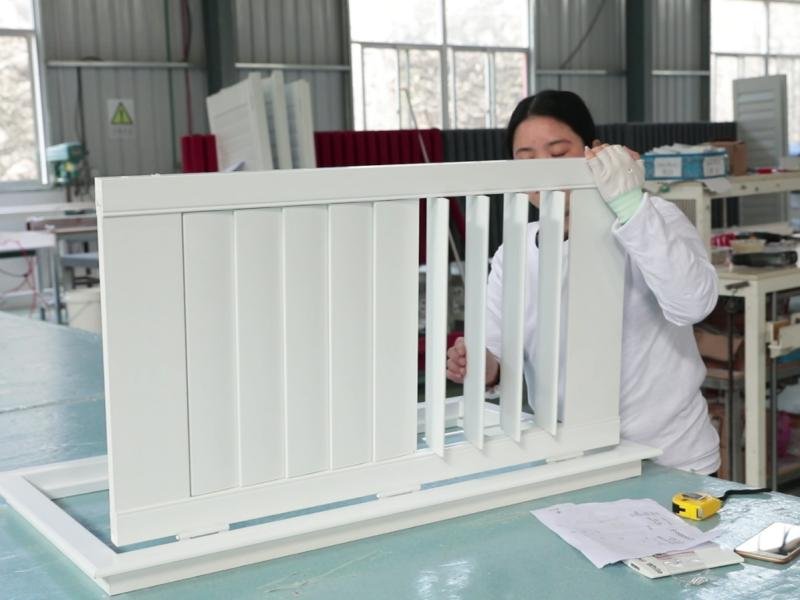
How do PVC, wood and aluminum change what the spec sheet should say?
Material changes which hidden variables decide long-term performance. PVC depends on extrusion tolerance, aluminum on alloy temper and hardness, and wood on moisture control during drying. A spec sheet that only says "PVC", "aluminum" or "solid wood" leaves out the facts that matter most.
| Material | The variable that is easy to miss | What we do, and what to request |
|---|---|---|
| PVC | Wall-thickness tolerance | Our design tolerance is ±0.1mm, checked on the extrusion line every 30 minutes. Ask for the tolerance and the inspection frequency |
| Aluminum | Alloy temper (T5 versus T4) | We use 6063-T5 and require a hardness report per batch, with Vickers hardness at 60 HV or more. Ask for the temper and a hardness test report |
| Wood | Moisture gradient between surface and core | Drying cycle of at least 18 days; incoming checks compare surface and core, with a difference of 2% or less. Ask how moisture is measured |
The tolerances, inspection frequencies and acceptance limits in this table are our own control standards, not industry mandates, so ask every supplier for theirs.
PVC. A wall-thickness tolerance that drifts from ±0.1mm to ±0.3mm still passes a visual check at the factory. Years later, thermal expansion can turn that drift into light leaking through a closed panel. This is why we measure wall thickness on the line and not only at final inspection. We run more than 50 PVC extrusion lines and 200+ profile sections in-house, which lets us control that tolerance at the source. If yellowing is your concern, read why PVC plantation shutters turn yellow.
Aluminum. T5 and T4 look identical, but T5 has a yield strength of about 145 MPa against 110 MPa for T4. In a gear-linkage design, the pivot holes in softer T4 material can enlarge by 0.1–0.2mm after 3–5 years of repeated tilting, and louvers then stop holding their position in the middle. Because the finish cannot reveal this, we ask for a hardness report instead of relying on a supplier's declaration. The full argument is in T5 vs T4 aluminum. For projects near the sea, coastal powder coating is the next spec to check.
Wood. Case hardening happens when the surface of the timber dries first and locks in its dimensions while the core stays wet. A pin-type moisture meter reads only the outer 5–8mm, so it can show a passing number. The warping appears later, after the container has crossed climate zones. That is why we cut sample sections and measure both surface and core. We cover this in case hardening in wood shutters.
Every material has limits, and we state them to customers directly. PVC is not permanently rigid. Its colour stability over time is strong, but over a ten-year period, louvers can develop a slight sag of about 0.3–0.5mm in the direction of gravity. It does not affect appearance, but it means PVC is much better than wood in this respect, not immune.
How do I turn this glossary into an RFQ checklist for a plantation shutters supplier?
Turn each term above into one field on your enquiry: louver width, control structure, material and temper, hinge specification, panel size and mount type, packaging protection, and delivery schedule. A quote that answers every field lets you compare suppliers on the same basis rather than on price alone.
| RFQ field | What to state or request |
|---|---|
| Louver width | Target width in mm (and inches if your market uses them) |
| Control structure | Standard tilt rod, concealed linkage, or gear linkage |
| Material | PVC, aluminum or wood, with species for wood |
| Temper / construction | Aluminum temper and hardness report; joint type for wood rails and stiles |
| Hinges | Material and rated load per hinge |
| Panel geometry | Opening size, mount type, need for T-Post or divider rail |
| Tolerances | Extrusion wall-thickness tolerance and how often it is checked |
| Packaging | Individual panel protection, and how damage responsibility is divided |
| Lead time | Plantation Shutters: 20–30 days; sampling: 3–7 days |
Two points on that table. First, our standard lead time for Plantation Shutters is 20–30 days, and we can usually turn samples in 3–7 days. Other product lines have different schedules, so we quote each one separately. Second, surface damage on PVC shutters cannot be repaired convincingly on site, because touch-up paint will not match the original finish. We therefore pack each panel individually and recommend that contracts name the point at which responsibility passes (factory, port or installation).
One more request for first orders: ask for a pre-production sample and for the batch tolerances to be attached to the contract. A sample is made carefully, and a production run is made on a line. The gap between the two can be managed, but it will not close by itself. Our quality control process is built around that gap, and our guide to vetting a plantation shutters factory in China walks through how to test it yourself. To see how these controls connect, read how a vertically integrated shutter factory works.
Behind these checks is a production base of 50,000+ ㎡ in Xiamen with 20+ CNC machining centres and 50+ PVC extrusion lines. That scale is useful because it lets one manufacturer control the profile, the hardware and the final assembly, which is what most of the terms in this glossary come down to.
Frequently Asked Questions
What does a tilt rod do on plantation shutters?
A tilt rod is the control bar that links all louvers in a panel so a single movement tilts them together. Standard systems use a visible front rod, while clearview designs hide the linkage. In gear-linkage systems, operating feel and wear depend on how accurately the shaft and louver pivots are aligned.
What is the difference between a T-Post and a divider rail?
A T-Post is a vertical post that splits a wide panel into sections and supports the louvers in the middle. A divider rail is a horizontal rail that splits a tall panel into upper and lower sections, each tilting independently. Which one you need depends on opening size, material and louver width.
Does louver width affect how long plantation shutters last?
Indirectly, yes. Common widths are 63.5mm (2.5"), 89mm (3.5") and 114mm (4.5"). Wider louvers and heavier panels put more load on hinges and the tilt linkage, so width should be specified together with hinge rating and linkage design, not chosen on appearance alone.
How can I tell whether aluminum shutters use T5 temper?
You cannot tell by eye, because T4 and T5 look identical. Ask for the alloy and temper in writing, and request a hardness test report for each batch. We require Vickers hardness of 60 HV or more for our 6063-T5 profiles, and we do not rely on the supplier's declaration alone.
Ready to check a specification?
If you assemble shutters in-house, send us the louver width, material and hinge specification you need, and request a component or semi-finished product quote. Our component supply team will confirm what we can match and what needs adjusting before you order.
If you buy finished shutters for resale, you can also ask for our wholesale specification sheet and lead time schedule, or contact us with your target market.
ASTM's scope page for the standard covering adhesives used in finger joints of nonstructural lumber products, useful if you want to see what the specification actually evaluates. ↩