
We've been extruding our own PVC profiles across 50+ production lines for close to two decades, and if there's one question wholesale buyers ask us more than any other, it's this: why does one batch of PVC plantation shutters stay bright white for a decade, while another starts yellowing before the first winter is even over? The answer isn't luck, and it isn't really about "quality control" in the vague sense most suppliers throw around. It comes down to one specific ingredient ratio that almost never makes it into a spec sheet — until a customer starts asking the wrong questions after it's too late.
Why do some PVC plantation shutters turn yellow within 18 months?
The core variable is how much titanium dioxide (TiO₂) is in the PVC compound. TiO₂ is the pigment that gives PVC shutters their white opacity and, critically, their resistance to UV-driven discoloration. For orders headed to high-UV markets — Southern Europe, the US South and Southwest — our internal standard is a minimum of 10 phr (parts per hundred resin) of titanium dioxide. That's meaningfully higher than the 4–6 phr level we've seen some suppliers use as a way to shave cost out of a quote.
This isn't a cosmetic difference. Shutters built at the lower 4–6 phr range typically show visible yellowing within 12–18 months of installation in strong sun exposure. At the point a shipment leaves the factory, a low-TiO₂ shutter and a properly formulated one can look identical — same whiteness, same gloss, same finish. The gap only becomes visible on the wall, in a customer's home, well after the container has cleared customs and the invoice has been paid.
| Factor | Low-cost formulation (common in the industry) | Our internal standard |
|---|---|---|
| TiO₂ content | 4–6 phr | ≥10 phr |
| Typical time to visible yellowing (high-UV exposure) | 12–18 months | Significantly delayed |
| Detectable at shipment inspection? | No — appearance matches spec | No — requires compositional verification |
| Verification method | Supplier's stated formula (unverified) | Batch TGA report |
We require a TGA (thermogravimetric analysis) report on every batch to confirm the actual TiO₂ loading — not just a formulation declaration from the compound supplier. TGA works by heating a sample and measuring weight loss at controlled temperature stages, which reveals the actual inorganic filler content rather than relying on a paper spec that may or may not reflect what went into the extruder that day.
How is UV yellowing actually measured, instead of just eyeballed?
We test PVC shutter resistance to yellowing using ASTM G1541, an industry-standard accelerated weathering method — not a proprietary test we invented. The cycle we follow is Cycle 1 of the standard: UV-A lamps at 340nm running a 4-hour UV exposure at 60°C, alternating with a 4-hour condensation cycle at 50°C, repeated continuously.
Color change is measured as ΔE using the CIE 20002 formula, which quantifies the visible difference between a tested sample and its original color. After 500 hours of this cycle, the grading we use is:
| ΔE after 500 hours (ASTM G154, CIE2000) | Rating |
|---|---|
| ≤ 1.5 | Premium grade |
| 1.5 – 3.0 | Acceptable |
| > 3.0 | Fails to meet our standard |
We can provide third-party lab reports from independent testing houses such as SGS, Intertek, or BV, with the batch number of the formulation noted on the report for traceability. We'd flag one honest caveat here: ASTM G154 is an accelerated aging test, designed to compress years of real-world UV exposure into a controlled lab cycle — it's a strong predictive tool, but it's a simulation, not a substitute for the specific microclimate a shutter will actually live in.
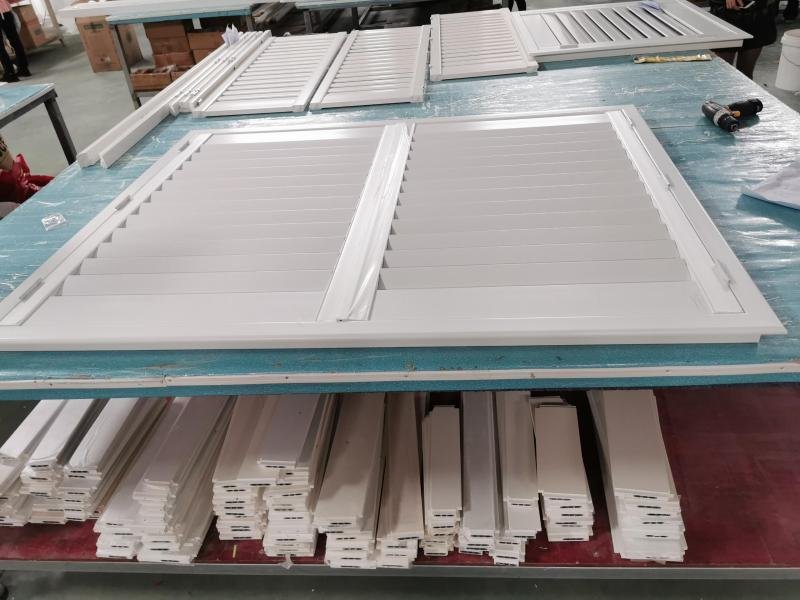
Why can't you spot a low-TiO₂ shutter just by inspecting the shipment?
This is the part that catches buyers off guard: passing an outgoing inspection tells you almost nothing about how a PVC shutter will hold its color over time. Visual inspection, dimensional checks, and even a basic whiteness reading at the factory will look the same whether the compound has 5 phr or 10 phr of TiO₂. The failure mode is delayed by design — it only shows up once the product has spent enough cumulative UV hours in the field, by which point the shipment has long been accepted, invoiced, and installed.
This is why we don't treat a supplier's formulation declaration as sufficient on its own. Our position is straightforward: a compound formula sheet describes what should be in the batch — a TGA report confirms what actually is. This UV resistance check sits alongside the other checks in our six-stage quality control system, from incoming material inspection through final packaging. For any buyer sourcing PVC shutters for a high-UV end market, we'd suggest treating a TGA report the same way you'd treat a mill certificate for structural steel: not paperwork, but the one document that tells you whether the thing you're buying matches the thing you were quoted.
Is PVC completely immune to change over time?
We want to be direct about this, because it's a different question from yellowing and one we think suppliers should be upfront about: PVC is not a material that never changes shape. Its color stability, when formulated correctly, is genuinely excellent over long periods — that's the whole point of getting the TiO₂ ratio right. But structurally, PVC plantation shutters can develop a small amount of gravity-driven bowing over time, typically in the range of 0.3–0.5mm across a 10-year service life.
This isn't a defect and it isn't something a higher TiO₂ loading changes — it's a separate physical property of the material under sustained gravitational load. In practical terms, it's rarely visible to the eye and it's still meaningfully less than what solid wood shutters experience under humidity cycling. We think it's worth saying plainly rather than letting "PVC never changes" become an unspoken assumption a customer later feels misled by.
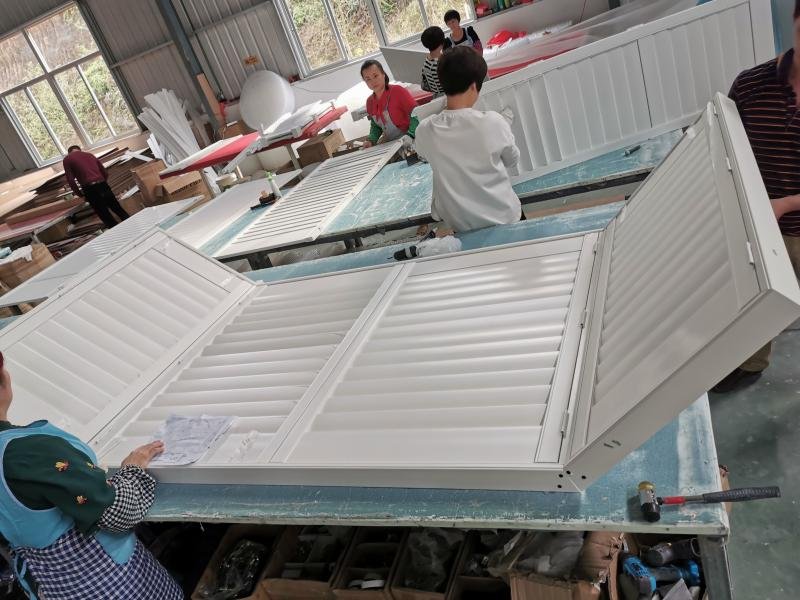
What should buyers ask a supplier before placing a plantation shutters order?
If you're evaluating PVC plantation shutter suppliers for a market with strong UV exposure, three questions will tell you more than a sample swatch ever will:
- What is the TiO₂ loading (in phr) for this specific compound, and can you provide a TGA report to confirm it?
- Do you have ASTM G154 test data for this formulation, and at what ΔE rating after 500 hours?
- Can a third-party lab (SGS, Intertek, or BV) issue that report with the batch number referenced?
A supplier who can answer all three with actual documentation — rather than a verbal assurance that "our quality is good" — is telling you something concrete about how their product will look in year two, not just on the day it ships. This is the standard we hold our own PVC lines to across the 200+ profile designs we run through our extrusion process, and it's the same standard we'd encourage any wholesale buyer to require before signing off on a container.
Want to see the TiO₂ compound data behind your next PVC shutter order?
Request our TGA compound verification report and ASTM G154 UV test results before you place a container order — so you know what you're getting before it ships, not eighteen months after it's installed.
Request TGA & UV Test Reports →
FAQ
Do all PVC plantation shutters eventually turn yellow? Not if the compound is formulated correctly. Yellowing is driven primarily by insufficient titanium dioxide (TiO₂) content in the PVC compound, not by an unavoidable property of PVC itself. Formulations with an adequate TiO₂ ratio resist UV-driven discoloration for far longer than low-cost alternatives.
How can I tell if a PVC shutter supplier is using a low-TiO₂ formula? You generally can't tell by inspecting the shipment — a low-TiO₂ shutter looks identical to a properly formulated one at the point of delivery. The only reliable way is to request a TGA (thermogravimetric analysis) report that verifies the actual TiO₂ content in the compound, rather than relying on a supplier's stated formulation.
What is ASTM G154 and why does it matter for PVC shutters? ASTM G154 is an industry-standard accelerated weathering test that simulates long-term UV exposure using UV-A lamps and condensation cycles. It's used to measure how much a PVC sample's color shifts (ΔE) after a set number of testing hours, giving a predictive indicator of real-world yellowing resistance.
Is a small amount of PVC shutter bowing over time normal? Yes — PVC shutters can develop minor gravity-related bowing over a long service life (in the range of a few tenths of a millimeter over a decade), which is a separate structural characteristic unrelated to color stability. It is not considered a defect and is generally not visible to the naked eye.
What should I ask a PVC plantation shutters supplier before ordering? Ask for the TiO₂ loading in phr for the specific compound being used, request a TGA report to verify it, and ask whether ASTM G154 test data is available with a documented ΔE rating after 500 hours of testing.
This is the fluorescent UV lamp exposure practice the plastics and coatings industry uses to simulate long-term sunlight and moisture damage in an accelerated lab setting. ↩
This is the internationally standardized formula for quantifying how visually different two colors are, refined to match how the human eye actually perceives color shifts. ↩