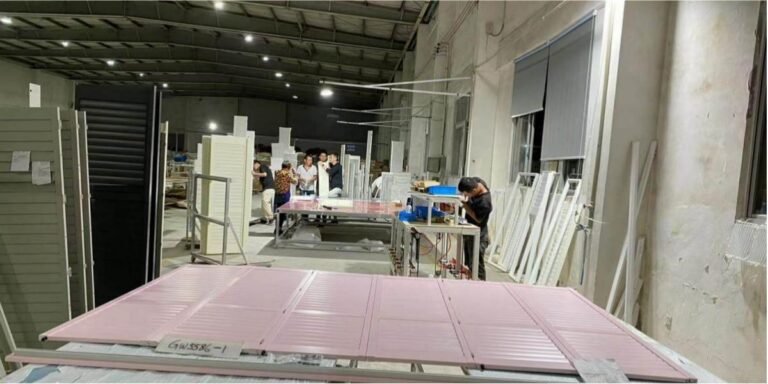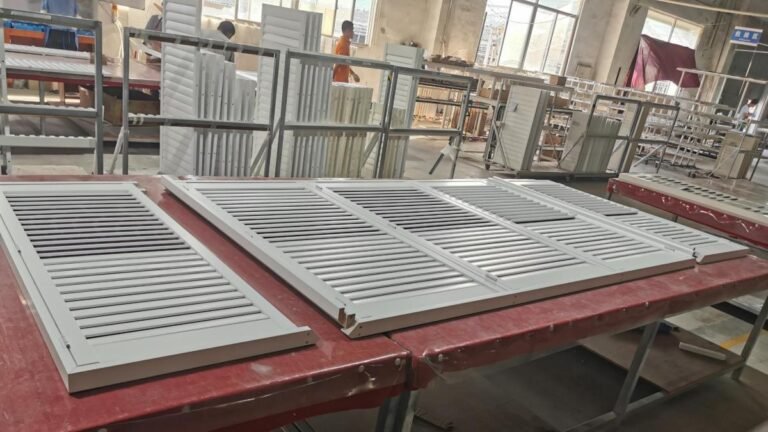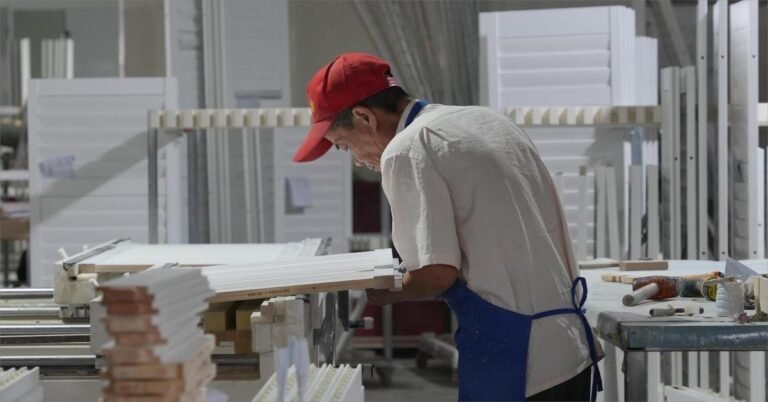

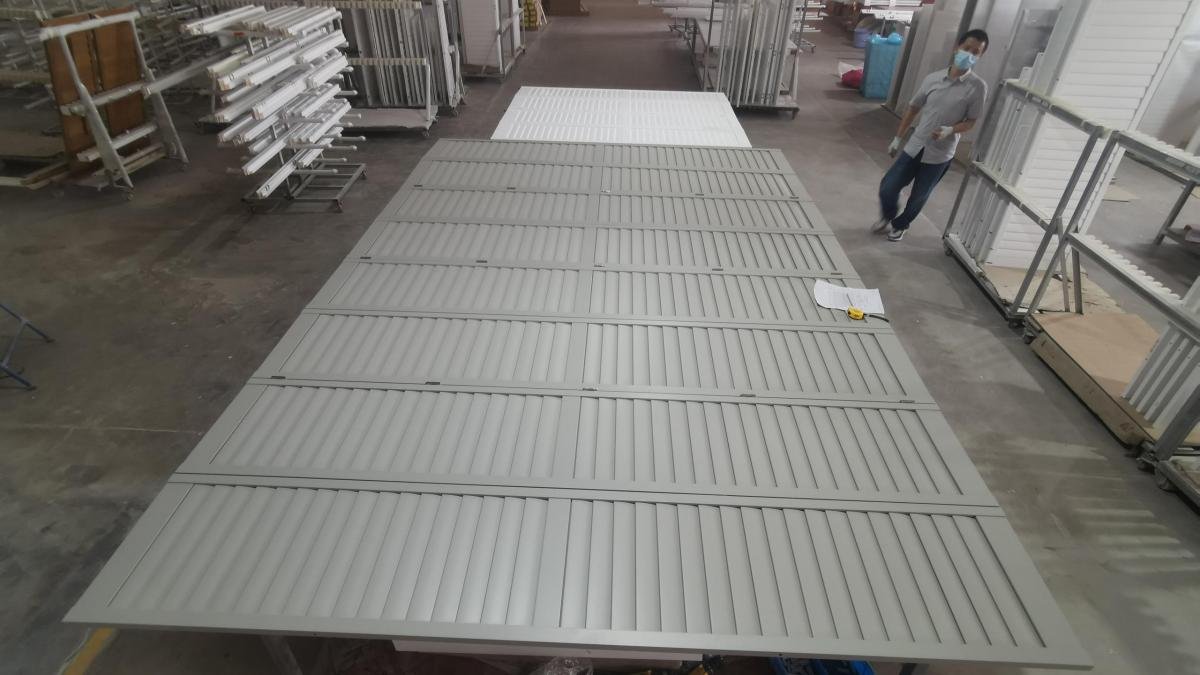
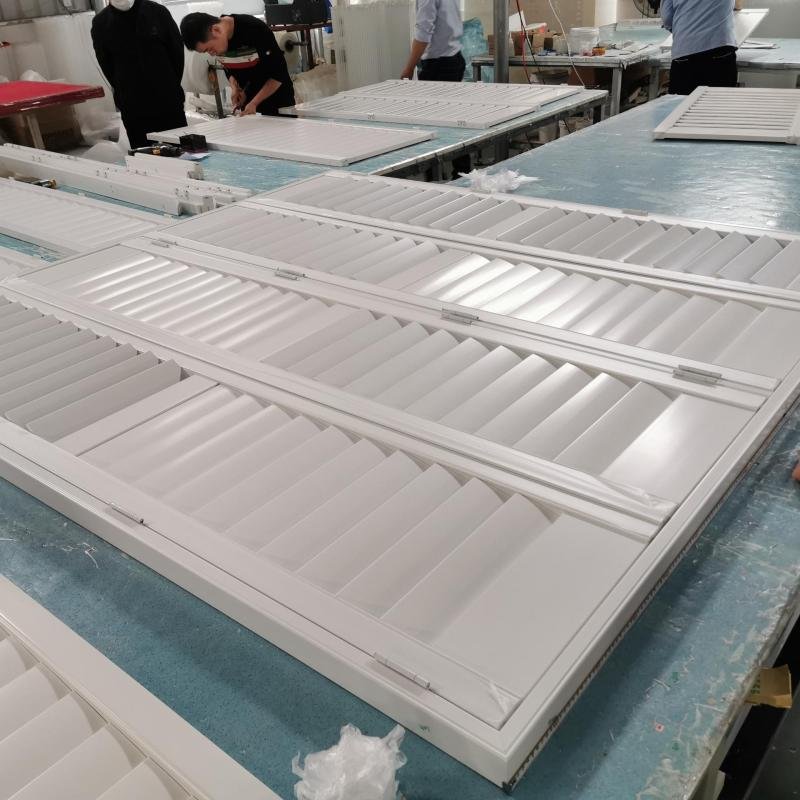
Our aluminum plantation shutters are built on an in-house extrusion and powder-coating line inside a 50,000+ ㎡ facility staffed by 400+ people, and one material decision made at the extrusion stage — long before a shutter ever reaches a container — quietly determines whether the louvers on that shutter will still hold their tilt position in five years. That decision is temper: T5 versus T4. It's a spec that never shows up on a spec sheet a buyer glances at, never shows up in a sample inspection, and never shows up on the day the product is installed. It only shows up later.
If you're sourcing plantation shutters, vetting a new aluminum supplier, or trying to understand why one factory's aluminum shutters seem to "loosen up" faster than another's, this is the variable worth understanding before you sign a PO — not after a customer complaint.
What's the actual difference between T4 and T5 aluminum in plantation shutters?
T5 and T4 describe two different heat-treatment states of the same 6063 aluminum alloy, and the difference is structural, not cosmetic. Our aluminum shutter frames are extruded in 6063 aluminum and processed to a T5 temper — extruded, then directly cooled, followed by artificial aging (a controlled reheating step that stabilizes the metal's internal structure). This gives the material a yield strength of approximately 145 MPa.
T4 temper skips the artificial aging step and relies on natural aging at room temperature instead. It's faster and cheaper to produce, but the resulting yield strength comes in meaningfully lower, at approximately 110 MPa. That's roughly a 30% strength gap between two extrusions that, on a shutter, look and feel completely identical.
The alloy — 6063 — is the same. The extrusion die is the same. What differs is a heat-treatment step that happens inside the factory, invisible to anyone downstream.
Why don't you notice the difference until years after installation?
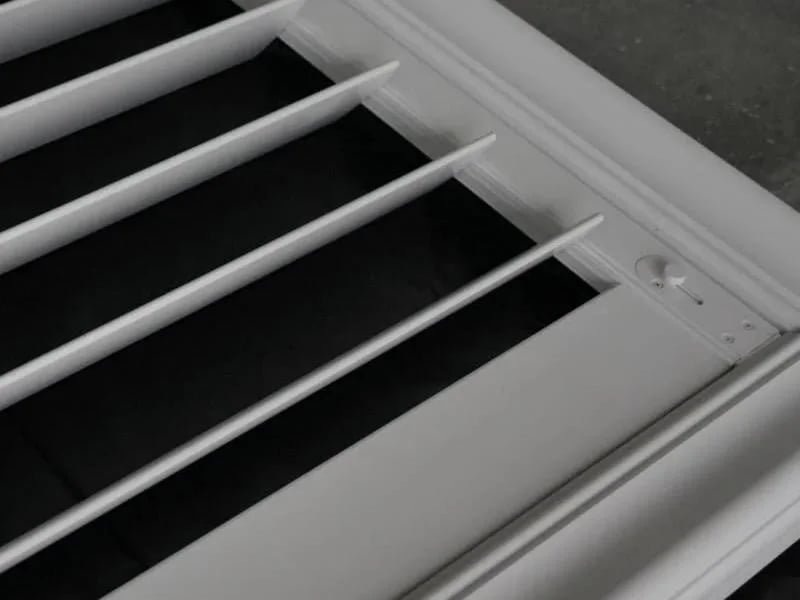
The strength gap doesn't affect how a shutter performs on day one — it affects how the material holds up under years of repeated mechanical stress at the pivot points. Aluminum plantation shutters with a worm-gear tilt-rod system rely on pivot pins at each louver to hold tilt position against gravity, hundreds of times a year, for the life of the product.
Under that cyclic load, T4 material's lower yield strength means the pivot-pin holes gradually deform. Based on our internal experience with this failure mode, T4-temper pivot holes tend to enlarge by roughly 0.1–0.2mm after about 3–5 years of normal use. That sounds small, but it's enough clearance for a louver to stop holding its tilt angle and settle toward horizontal on its own — a symptom installers and end users usually describe as "louver drop," where the middle of a shutter panel won't stay where it's set.
This is why the temper difference is so easy to miss during sourcing: a T4 sample and a T5 sample perform identically in a showroom, on an install day, and for the first year or two of use. The failure mode is delayed, which makes it one of the harder defects to catch through a standard sample evaluation — you're not testing for a flaw, you're testing for a strength margin that only matters after years of accumulated load cycles.
Is temper the only "invisible spec" that affects long-term operation?
No — a second, related spec sits downstream of temper entirely: how precisely the worm-gear tilt-rod assembly is aligned during assembly. Even with correct T5-temper material, the gear-driven tilt mechanism itself has a tolerance that matters over time: the concentricity between the worm-gear shaft axis and each louver's pivot-hole axis.
Our internal assembly standard requires this concentricity deviation to stay within ≤0.2mm. Go beyond that tolerance and two things happen. First, the tilt operation itself starts to feel heavier — based on our internal assessment, misalignment beyond this threshold increases operating torque by roughly 15%, which is often the first thing an end user notices, well before anything visibly fails. Second, and more consequentially, the PA66 gear component wears under eccentric (off-center) load at roughly 2.3 times the rate of a properly aligned, concentric assembly. Over an 8–10 year service life, that accelerated wear is what eventually causes the gear teeth to degrade to the point where the tilt mechanism can no longer transmit motion reliably.
Like temper, this isn't something a buyer can catch by inspecting a finished shutter — it's an assembly-line control point. We use a dedicated fixture to check gear-rod concentricity during assembly, a step we've found a number of smaller factories skip, but one we consider necessary to back a long-term warranty commitment on the aluminum line.
How do you verify which temper — and which assembly tolerance — you're actually being sold?
Because T4 and T5 aluminum are visually and dimensionally identical, and gear-rod alignment isn't visible from outside the housing, the only reliable way to confirm either is direct testing — not a visual inspection and not a supplier's material declaration. This is a point worth being direct about: a factory can tell a buyer a shutter is "T5 aluminum" with a properly aligned tilt mechanism, and there is no way to verify either claim by looking at the part, weighing it, or checking it against a drawing.
Our internal control standard is to require a hardness test report for each batch of aluminum profile, with T5-temper material expected to test at Vickers hardness ≥60HV, and to check gear-rod concentricity against the ≤0.2mm tolerance using a dedicated fixture during assembly. We treat both as required verification steps rather than something we take on a supplier's word — the same underlying logic we apply elsewhere in our QC process, where claims about material or coating performance get checked against a test result rather than accepted at face value. For coastal-market aluminum finishes, for example, coating durability claims are verified against salt-spray exposure testing (the industry reference method here is ASTM B1171) rather than taken on a spec sheet — a different property than louver temper or gear alignment, but the same principle: performance claims that can't be seen should be tested, not assumed.
If you're evaluating an aluminum shutter supplier and long-term operation matters to your application — high-frequency commercial use, hospitality projects, or any setting where the product needs to hold up over a long duty cycle — it's reasonable to ask for both a hardness test report and confirmation of assembly-stage concentricity checks as part of your quality documentation, the same way you'd ask for a material certificate on any structural component.
T4 vs T5 Aluminum: Side-by-Side Comparison
| Property | T4 Temper | T5 Temper |
|---|---|---|
| Processing | Extruded + natural aging (room temperature) | Extruded + direct cooling + artificial aging |
| Yield strength | ~110 MPa | ~145 MPa |
| Pivot-pin hole deformation | ~0.1–0.2mm enlargement after ~3–5 years under cyclic load | Substantially more resistant to this deformation mode |
| Visual/dimensional difference from the other temper | None | None |
| Verification method | Hardness test (our internal threshold: T5 ≥60HV Vickers) | Same |
Gear-Rod Concentricity: What's at Stake Beyond Tolerance
| Condition | Operating Torque | Gear Wear Rate | Typical Outcome |
|---|---|---|---|
| Within ≤0.2mm concentricity (our standard) | Baseline | Baseline | Gear teeth hold up across 8–10 year service life |
| Beyond ≤0.2mm concentricity | ~15% increase | ~2.3× baseline | Tilt feel heavier early; accelerated gear degradation over time |
Does T5 aluminum and tight assembly tolerance solve every long-term performance issue?
No — T5 temper and concentricity control address structural fatigue and mechanical wear, but neither eliminates the effect of thermal expansion on operating feel in cold climates. We think it's worth being straightforward about this limitation rather than presenting these controls as a solution to every long-term aluminum performance question. Aluminum shutters are more dimensionally stable than PVC or wood across most conditions, but in genuinely cold climates — parts of Europe and North America that see sustained winter freezes — the aluminum frame's thermal expansion and contraction still has a measurable effect on tilt-rod operating feel as temperatures swing.
This isn't a temper or assembly issue; it's a property of aluminum as a material, and neither T5 strength nor tight gear alignment changes the coefficient of thermal expansion. For projects in cold-climate regions, we raise this during project drawing confirmation and recommend the design account for a temperature compensation gap in the tilt-rod assembly, rather than leaving it as a surprise the installer or end user discovers on the first hard freeze.
The bottom line for buyers
T5 vs T4 aluminum — and gear-rod concentricity alongside it — are good examples of specs that can't be judged by looking at a product. Both are verified through testing, and both only matter because of failure modes that show up years after delivery, not at inspection. If you're comparing aluminum shutter suppliers, asking for hardness test documentation and concentricity-check confirmation alongside standard dimensional QC is a reasonable, specific question — and one that tends to separate suppliers who control these variables from those who don't track them at all.
If you'd like to see how we document temper and assembly-tolerance verification as part of our aluminum shutter QC process, we're glad to walk through it — or if you're comparing suppliers for a bulk order, take a look at our wholesale plantation shutters program.
Explore our aluminum plantation shutter line →
Request our aluminum shutter QC documentation — hardness test reports, concentricity-check records, and batch verification data for your supplier evaluation.
Frequently Asked Questions
How can I tell if aluminum plantation shutters are T5 or T4 temper? You can't tell by looking, weighing, or measuring the part — T4 and T5 aluminum are visually and dimensionally identical. The only reliable way to confirm temper is a hardness test; T5-temper material should test at a Vickers hardness of roughly 60HV or higher.
Why do aluminum shutter louvers stop holding their tilt position after a few years? This is typically caused by pivot-pin hole deformation under repeated mechanical load. Lower-strength T4-temper aluminum is more prone to this wear pattern, with pivot holes gradually enlarging over roughly 3–5 years of normal use until the louver can no longer hold its set angle.
Does using T5 aluminum guarantee a shutter will perform well long-term? No. T5 temper addresses pivot-point structural fatigue, but it doesn't eliminate the effect of thermal expansion on tilt-rod operating feel in cold climates, and it doesn't compensate for poor gear-rod assembly alignment, which is a separate tolerance issue.
What is gear-rod concentricity, and why does it matter for aluminum shutters? It's the alignment between the worm-gear shaft and each louver's pivot-hole axis in the tilt mechanism. Misalignment beyond a tight tolerance increases operating torque and accelerates gear wear, which can shorten the mechanism's effective service life well before the frame material itself shows any issue.
What should I ask a supplier to verify aluminum shutter quality before ordering? Ask for a hardness test report confirming temper (T5 should test ≥60HV Vickers) and confirmation that gear-rod concentricity is checked during assembly. Neither can be confirmed from a sample or a spec sheet alone.
A quick primer on how the salt-spray (fog) test works and what industries rely on it for corrosion evaluation. ↩